Showing posts with label Working in Japan. Show all posts

April 11, 2011

違うんだ!

会社に入ってから一週間が過ぎました。
オフィスワークなので、パソコン、電話、コピー機を使う毎日。
日本で働いた時とそれは全く一緒。

でも、もちろん日本の会社とは違うところに気づきました。

まず、勤務時間!
月給で、日常勤務時間が7.5時間プラス30分の昼休み。
7時から9時の間に出社で、3時から5時に退社。
ゆえに、例えば私のように、8時に出社したら、
理想的な退社時間は4時ですね。

7.5時間以上働いてたら、その余分が溜まっています。
4日間、毎日2時間余分に働いたら、一日分の休みをとれます。
しかし、毎日6時には帰らないといけません。

「お先に失礼します」とか言わなくて、そのまま退社。
そこが一寸冷たいと思いました。

雰囲気
冷たいと言えば、今の会社の社風はそんな感じです。
同僚達は皆、自分の仕事だけに集中して、
会社全体で助け合ってやるという雰囲気はあまりないです。
毎日のように、割り当てられていない仕事があるのですが、
そのような仕事は、皆が敬遠して、
責任のなすりつけあいをするような感じのところがあります。

仕事中に
皆が違う時間に出社するので朝礼は全くない。
ラジオ体操が何より懐かしい。

事実上、通常の会議もない。
必要な時に会議が開かれるのかな。

コピーをとってから部屋に戻ったら、すっごいバナナの匂いがした。
あら!係長が直ぐそこでムシャムシャバナナを食べているんだ。
一つのことを思い出した。手短に言えば、
事務室でバナナを食べるのは一寸いけないことだった。

こんなところですよ。よく見たらカンガルーの標識があります。
でもまだ見たことない。

December 15, 2010

Productive working hours in Japan and Finland

As many of you know, I did my internship in Japan. The five months spent at a Japanese company formed my first real image of office work.

Now in Finland I've regularly been at an office, and can't but highlight the difference in working hours.

Ok, my spot is at the 2nd floor, where other people hardly show up, except to have meetings.

So there I am, writing the thesis as a good boy should. Then I go downstairs to pickup a bunch of printouts of academic publications... Down the stairs, to the door, and WHAT? Why are all the lights switched off and nobody's around any more? A quick, sherlock-like observation: everybody must have returned home... But what time is it? Nearly 4:30 pm. Right. Ok, this is Finland not Japan.

In Japan I was the first one to leave. And I left between 6 and 7 and sometimes around 8 pm. Others usually followed way later.

Is it possible that the Japanese office clerks work out the same (or higher) output in 10 or 11 hours as the Finnish do in 7 or 8? If not, then what accounts for the leftover time? Consider that overtime pay has nothing to do with this.

-日本語訳-
みなさんご存知のように、日本でインターンシップをしていました。この、日本の会社で過ごした5ヶ月間がそのまま、会社で働くことのイメージになっています。

現在フィンランドで、毎日のように会社に通っていますが、
最も大きな違いは、就労時間です。

私がいるのは、会議の時ぐらいしか人が上がってこない2階です。

そこで、いい子になって卒論を書いています。そして、学術誌を印刷しようと1階に下りると…なんで電気が全部消えて、誰もいないの???すぐに、シャーロックホームズのようにひらめきました!「ははあ、みんな家にもう帰ったんだな。でも、今何時だろう?もうすぐ4時半!?そうだ、ここは日本じゃなくてフィンランドなんだ。」

日本では毎日、私が一番最初に退社していました。いつも午後6時から7時ぐらいの間で、時々8時頃になってしまうことも。他の人達は、大抵それよりも遅かったです。

フィンランドの会社員が7、8時間ですることを、日本の会社員は10、11時間かけてするなんてことがあるえるのかな??もしありえないなら、残業時間を使って、日本人は何をしているのか??残業手当は出ないのに!

October 16, 2010

日本語の聞き違い

日本に滞在していた時の、日本語の聞き違いと、言い間違いをちょっと紹介!

と申します=とおもいます。
電話で答えたらありがちの間違いかもしれない。僕は電話の応答を禁止されていて良かった。
もし「株式会社ABCのアホと思います」と、お客様に言うと仮定してごらん。

お世話になります=おさわりになります!
事務所は静かなんですが、電話がよく鳴った。
いつも早口で聞いたから「いつもおさわりになっております!」になってしまった。
顧客サービスが密接な感じはいいんじゃない。やっぱり電話禁止されていてよかった。

気持ち=きむち
ずっと間違ってました。韓国料理は好きになったけど、もちも大好きだった。

看板=かばん
ゆみこを笑わせるために「ん」を忘れた。

川=がわ、橋=ばし
大分川と言うと「おおいたがわ」になる、弁天橋は「べんてんばし」になるので、僕は川のことは「がわ」、橋のことは「ばし」と思った。

教会=きょうかしょ
ある日、大分の留学生会館の近所で窃盗事件が起きて、会館に警察が聞き取り調査に来た。僕は、ちょうどその日に、怪しい人をよく見てよく覚えていたから、警察にそのことを話すと、「どこに行くところでしたか?」と聞かれたので、「きょうかしょです!!」と答えて、ゆみこさんに大笑いされた。

ズボン=ズボンボン
ちゃんと聞かなかったからね、こんな間違いもやってた。

感謝します=かんちょうします!
僕が最後のスピーチを家で練習しながら「皆さんに本当にかんちょうします!」と間違った。
ゆみこさんは爆笑したけど、わけがわからなかった。
ジェスチャー付きで説明してもらったけど、全然理解できなかった。
日本のユーモアかなと思ったんです。練習して、会社の全体会議で失敗をしなくて良かった!

July 5, 2010

Camping meanwhile the sky fell down

I went camping with the company employees. It rained and thundered like the end of the world was at hand but that didn't matter. Some 13 of us spent a night, stuffed in a lodge, eating, playing, talking and wishing there was a TV (to view soccer).


Near the campsite cascaded a slid-kind of waterfall. At first look it looked much fun and everyone wanted to ride down the smoothened rocks.


Closer look changed our mind. The people were bouncing down like loose stones - getting smashed to the stones and more or less hurt. Later it resolved that each year the slide demands casualties.


For awhile nobody wanted to follow their painful example but soon we grew stupider it and went to try it out. Result, red and blue skin and wet clothes and a heap of laughing.


The only way to the water fall was this mossy oldish tunnel. Looking at people walk through it seemed somehow supernatural and spooky, and reminded me of a popular TV-serie from the 90s, The X-Files.


The evening went on, and some of us including me stayed up talking until five in the morning. Nice time, nice people. The people who I work with are awesome but why working in Japan has to be so dull. There's no good without something bad, I guess.


Meanwhile, we were having all the fun and Germany was hurdling Argentina in South Africa the heavy rain caused landslides, floods and other nasty disasters in various locations of Japan.

In Kyushu part of road fell down the mountain face. When cars came around the curve they had no time to see the collapsed part and break but just drive straight off the cliff. In Tokyo streets turned to lakes.

June 13, 2010

Impressions of working in Japan: Work identity and private identity

A thing about Japanese that probably never will reveal to me is how differently they behave at work and in private. Let me explain. A normal office behavior is quiet, involves little laughter, a bunch of formalities, and a whole lot of stiffness. But when we are outside the office walls things change.

Last Friday, we had yet another nomikai to unofficially welcome the new employees. About 30 people from the top to the bottom of the hierarchy participated in this evening function that took place in a nearby izakaya and later continued at a too small karaoke room. It was all in all a fun occasion.


Anyhow, during the party I but wondered: "How the people I know as employees were able to go through such a quick and dramatic change?" Talkative, unrestricted, smiling and laughing loudly (the above photo explains everything).

Of course its normal and oftentimes advisable to distinguish between private and work behavior. Butt-scratching, nose-picking (the two things I unconsciously do) and all that doesn't belong to meetings or office environment; we all know that.

Yet it's not only behavior but its personality I'm talking about. To me it seems that I hardly know my colleagues when I see them in private. I ponder befuddled, "Are these really the same quiet people who I see sitting eight hours from Monday to Friday at the desk?"

Given that the change happened within in less than half an hour, during the walk from the office to the izakaya, it becomes even more difficult to believe. "Which personality is the real one, and which the played?" was the underlying question that remained. But in fact the answer, as difficult it is to swallow for me, might be: both are real. Perhaps I was brought up in a culture where person's personality is expected to be consistent.

Above all the puzzlement, being able to shift one's personality probably requires self control and therefore is an admirable skill itself.

May 22, 2010

Impressions of working in Japan: The unwritten rules

Long working day requires energy. Lunch at 12 is vital but not enough to up hold concentration until late evening.

A fruit in the afternoon would hit the spot, I thought. So accordingly, on my way to work, I bought a banana and placed it in my desk's drawer.

Afternoon came and my stomach started to grumble. I recalled the banana but at the same time made a note that actually I haven't seen anyone eating banana or the like during work.

Just to be on the safe side, I thought it's better to ask from a person next to me, "Is it alright to eat a banana here?" Instead of saying "Yes, of course", a reply that I had expected, we ended up having the following dialog:
- "Eat a banana? Eh, you mean like in the lunch time, right?

- "No, I mean like in the afternoon."

- "Afternoon you say? Hmm, I wonder about that. Afternoon
   is for working. Eating a banana would be like having a break,
   or other in words not working. Moreover, as you can imagine, the
   banana skin would make an awful mess."

- "Uh, I can imagine that. But then, why it's okay to drink coffee or
   tea and eat small sweets?"

- "That's a different thing. Drinking does not interrupt work, and small
   sweets can be eaten unnoticed.

- "I see (trying to figure the logic). So is this rule written somewhere?"

- "No. All rules are not written.

- "So it seems. Anyway, fruit would be better for health."

- "Maybe so."

Enlightening conversation, huh? I should have asked, "Why this rule is not written?", and maybe the reply would have been, "It doesn't make sense to write it", to which I could have concluded, "Yes, because its an insensible rule".

There are many unwritten rules. I get the feeling that rules have emerged first and then afterwards people have started to make up explanations to why such rule exists.On the other hand, for harmony's sake I better not drift into such debates anymore. Just comply to say "Yes, understood" and go on.

I took the banana out of from the drawer and brought it home.

Finally, if we're going to have a company costume party I'll be sure to wear this:

April 25, 2010

Impressions of working in Japan: Don't be like this if you are an employee in Japan...

Below is a list of features that Japanese would not like to see in their employees. Some of them are shared universally, some are apparent only in Japan. You can easily spot items that may become a barrier for foreign employees in Japan (e.g. a person like me). Don't be a kind of person who:

1. Can not perform a neat greeting
2. Does not take notes and therefore asks same thing several times
3. Can not use the honorific form of Japanese language
4. Is not eager to do the miscellaneous (small) tasks
5. Is not able to "report, contact, consult"
6. Repeats the same mistake
7. Can not reply promptly
8. Does not apologize for own mistakes
9. Instead of taking initiative waits for an order
10. Acts proud and intelligent but is not
11. Goes home without asking a senior, "Shall I help you?" and therefore has no spirit of cooperation.
12. Talks too much during working hours
13. Gets offended from a someone's warning
14. Can not prioritize and panics

(Conducted from a sample of 1030 female and male public sector workers aged 30 - 59)


Talking on my behalf: The most challenging point is no doubt number 3. Managing conversational Japanese is a challenge enough. Saying something like:ごめんどうですが、もういちどおこしいただけますでしょうか。" instead of a simple "またきてくれますか。" does not come out spontaneously. Both share the same meaning, which is in English: "Please come again".

The rest of the numbers are manageable but maybe not with the same attitude that Japanese have. For example, number 11: when your work time is over, how many times have you asked from a senior, "Is there something I could still help with?". I could force my self to this but in reality I'd probably not be honestly eager to help if it would mean unpaid overtime work and loss of free time. And anyway why it has to be a senior worker? Are they the only ones who deserve or are privileged to be helped?

Number 12. "Talks too much during working hours" is possible but needs quite a push. Can it really be so disruptive to talk at the work place? Of course it's never good to blabber around about every single thing - I'd hate that too. But a friendly and a cheerful conversation that is not only connected to work is nice to have. Yet, in Japan, the step from not talking at all to talking too much is seemingly short. I can't but wonder why we have to play official and serious during work.

〈日本語訳〉

このリストを見た後、日本で働く未来は暗くなった…。新入社員さんはここに気をつけて!

1.あいさつがきちんとできない
2.メモを取らず、同じことを何度も聞く
3.敬語が使えない
4.雑用を率先してやろうとしない
5.ホウレンソウ(報告、連絡、相談)ができない
6.同じ間違いを繰り返す
7.返事ができない
8.自分のミスを謝らない
9.「指示待ち」で自分から積極的に動こうとしない
10.プライドが高く、知ったかぶりする
11.多用な先輩に「手伝いましょうか」の言葉もなく帰るなど、協調性がない
12.仕事中の私語が多すぎる
13.注意すると「逆ギレ」する
14.仕事の優先順位が付けられずパニックになる

挑戦的なのは3番です。普通の日本語は難しいので、敬語はちっと…。例えば、「またきてくれますか。」と言うのは「ごめんどうですが、もういちどおこしいただけますでしょうか。」ゴーン!

他の番号は出来ても、日本人と同じような心掛けで行うことは、かなり難しい。例えば、11番:仕事が終わった時、よく「手伝いましょうか?」と聞いていますか?私も、しようと思えば出来ますが、本音は残業手当てもなく、自由な時間を無駄に使いたくありません。そして、なぜ"先輩"なのでしょう?後輩は手伝わなくてもいいですか?

「12.仕事中の私語が多すぎる」は簡単に気をつけることが出来る。でも仕事中に話すことは、そんなにいけないですか?もちろん、四六時中話してばかりなのは悪いし、私も嫌いです。でも、フレンドリーで快活な、仕事に関係ない会話もした方がいいと思う。日本では「全然話さない」のと「私語が多すぎる」という違いはかなり少ない。なぜ仕事中に、真面目で公的な様子を演じなくてはいけないのかと思っています。

April 12, 2010

Impressions of working in Japan: a 30 minute presentation of Finnish education system


Ha, I did it! I pulled off a presentation in front of a dozen employees without being nervous - and most of all in Japanese! Ah, feels utterly good!! A big thanks goes to the attentive audience and Yumiko, the greatest supporter of all!

April 11, 2010

Impressions of working in Japan: Credo (クレド)

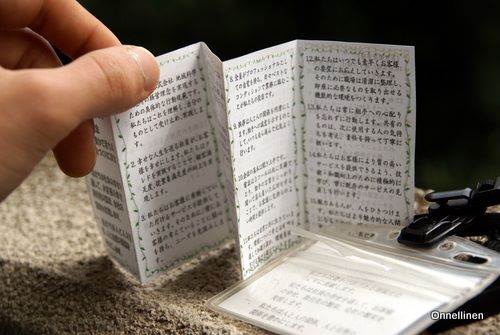
Here's a plastic pocket that we carry around during the office hours. It holds in two items: employee's name tag and a credo.

Ok, name tag is a easy to explain, it shows employee's name and other details. But what's a credo? The word is written in Katakana, indicating a foreign origin. Anyone who has studied Latin might be able to identify the meaning since the word comes from Latin. Let's see what the definition according to Collins English Dictionary is:
Credo ('kri:dəʊ, 'kreɪ-) n, pl -dos
    1. the Apostles' Creed or the Nicene Creed
    2. a musical setting of the Creed
    [C12: from Latin, literally: I believe; first word of the
    Apostles' and Nicene Creeds]
credo ('kri:dəʊ, 'kreɪ-) n, pl -dos
     any formal or authorized statement of beliefs, principles,
     or opinions
credo ['kri:dəʊ, 'kreɪdəʊ] s uskontunnustus (Finnish)


So it's a set of beliefs but what is it used for? 35 phrases are written in the neatly folded sheet of paper. Almost every morning during a morning assembly the plastic pocket is opened and one phrase read out loud. That is followed by a discussion accordingly.


Phrases in the credo mean good but when people read them in a low and slow voice it sounds awfully religious, just like in a church when doing a confession. I'd suggest to add a pinch of cheeriness to the voices to make the atmosphere better. On the other hand, on those early morning assemblies everybody's damn tired, which might be just the cause for aphonic and low voices.

Question: Is credo merely a feature of Japanese companies or are they used widely?

March 21, 2010

Impressions of working in Japan: Art of stapling

'The correct way'
In every situation Japanese appear to have one correct way to do something. It shows up for example in the exchange of business cards. In Japanese daily life one can observe hundreds of things that are trained hard so that they would be performed in the right way. Other methods that can be viable are not considered eagerly but omitted easily.

Related to that, here is what happened last week at work:

I was stapling two paper sheets together. On a task so basic and easy it did not occur to me there could be 'the proper way' to do it. So without too much thought I had stapled a neat pile together.

Soon someone came to me. After staring my work for a moment she corrected, "Lauri, the staple should be affixed diagonally - not upright. The paper will tear off easily if you staple upright." What a noble advice and well justified. Diagonally that is then.

With new instructions I continued the job. A moment passed and another person came me and said, "The staple should be about 3 cm away from the edges. You have affixed them too near the corner." Er... Right, diagonally, 3 cm from the edges - that is the art of stapling.

What could be the core reason for all the rules that sometimes seem irrelevant for me? Perhaps Japanese people from their nature try to seek safety and avoid uncertainty and therefore they need heaps of guides to follow and to create predictability. One one hand, predictability is good and can be justified with many positive aspects. On the other hand, list of customs and guides is no good and leads to boringness and single mindedness.

A problem can have multiple solutions.
Same goal can be reached in several ways.

March 15, 2010

Impressions of working in Japan: Office atmosphere

The silent office
There are a little over 25 people toiling and breathing the thick air of this room. When I lift up my sight over my monitor and look around everyone appears to be working tediously.

Tapping of the keyboard and frequent mouse clicks are faint but constant sounds on the background. Printer occasionally interrupts the quiet air. The noise it produces seems unusually loud when it swiftly thrusts out a pile of A4’s.

In my mind I think: here I am sitting in an office striving to blend in and be like the people around me. Yet, the feeling of being foreign is not going anywhere. I recall the song ‘English man in New York’ by Sting. Change it to Finnish man in Oita and it’s quite a match for this scene. Maybe I'll whistle it a little... On the other hand better I'd better not.

Time to stop wondering like this. I take a breath-full of the heavy office air, lower my sight back to monitor and join the orchestra of keyboards’ and mice’s.

March 5, 2010

Impressions of working in Japan: Pay time

The way to receive monthly wage
In Finland (and probably in many western countries) receiving monthly wage is not a notable episode. For most it is simply an unnoticeable electric transaction from a bank account to another.

Not long ago I learned the custom of this Japanese company: Boss's wife, a senior of her age, is the one who literary deals out the pay slips. She strolls around the office, stops at every one's desk, says a few not so motivating words like: "Straighten your posture" and finally hands out the pay slip. The word "pay slip", can be used is in its original meaning since the paper that tells your monthly salary is indeed long and thin (around 2 cm wide and 15 long) wedge of paper.

The character of this woman, plus the fact that she is boss's wife but not employed here is what makes it even more noticeable event. Oftentimes she throws discomforting jokes to the air and everyone laughs showing both sympathy and pity on their face. This is what she said in a loud voice after we met first time:
名字は本当にアホですか?!可笑しい!
(リングを見かけた)ええ、結婚していますか?
24歳ですか?!可笑しい!


Surename, is it really Aho?! Strange!
(after seeing a ring)
Whaat, are you married?!
And 24 years old?! Strange!
If I think of it, it seems that the one who really rules in the company is not the boss but the woman behind him, that is his wife. Somebody once said “Japan is ran by Japanese men but steered by Japanese women. There could be a seed of truth in that sentence.

March 4, 2010

Impressions of working in Japan: Sneezing

Now it is early spring. The pine trees, that Oita is full of, began to spread pollen (siitepöly or 花粉). I couldn't help noticing that many have trouble with their dripping noses also in our office.

Well-mannered Japanese carry tissue paper at all times, and visit the bathroom to discharge a nose-full of goo. So I imagined. But now it seems that people are just sneezing liquids back into depths of their noses. In other words doing the opposite of blowing. When 10 people sneeze once every five minutes it makes quite an orchestra in an office. Perhaps I could make a suggestion to place a tissue box to the middle of the office, so that everyone can have a relief.

As far as I'm concerned blowing one's nose is regarded embarrassing in Japan. And more precisely the noise it makes embarrasses not the action itself. Well, it understandable since the blowing sound may be hilarious. Yet, if blowing a nose is embarrassing, why isn't the inwards sneezing thing, I wonder?

March 1, 2010

Impressions of working in Japan: New recruits

1st of March: New recruits
March in Japan is the time of the year when companies hire new people, that is to say fresh university graduates. The company I work in recruited 11 employees at once. Out of that group there's only female. Now that is a rather male-skewed distribution, isn't it?

It's intriguing to observe the new workers on their first day. They are so diligent and careful. It doesn't matter what is asked or told to do, a firmly pronounced "HAI!" (Eng. YES!) seem to be the single applicable answer. It is untrue, but ironically, if someone would say, "Today you have to line up in front of that open window over there and jump one by one down from the 4th floor", they would do it and with their best effort like good old Lemmings. Boing!

Although in future they possibly will have specific (and more demanding) positions, right now each one of them does the same tasks e.g. inputting survey data into a database. Unlike in most western companies, there new recruits are not hired for particular jobs, instead they find their spot and field of interest by time.

Neckties little too tight, bowing to everyone and everything, a drop of sweat running down the forehead. Uncomfortable and out of course is the overall impression. Hih, just like me little over a week ago.

On this weekend they will have their first nomikai, an evening spent drinking with other employees. Nomikais are demerit for health but merit for building good relationships, it seems.

February 25, 2010

Impressions of working in Japan: Lunch

12:00 - 13:00 Lunch break
Time stand up and go to the lunch room, take out the lunchbox and get nourished. At lunch people socialize and have friendly conversations with other employees because during work people hardly talk, and if they do it is plainly work related. This is an important hour. It breaks the almost silent office atmosphere and gives an opportunity to refresh oneself.

Almost all the men in the office do not join the common room for lunch. They prefer to eat on their desk and use computer simultaneously. I was curious to ask is the reason for this. It turned out that while eating they browse news sites. This they do because they need topics to have a lively conversation with their customers when they meet in future.

That could be efficient use of time but leads me to think of an absurd question: in their shoes, which one you would prefer to browse: A flock of office ladies at the cafeteria or news sites in the Internet?

--
The internship began last week. Now, after having digested the initial information flood I'll start to write about how it is like to work in Japan. This post marks the first entry in the series of working in Japan.
 
 
Copyright © Better together...